Computational Musicology
Exploring music through data and algorithms
Projects
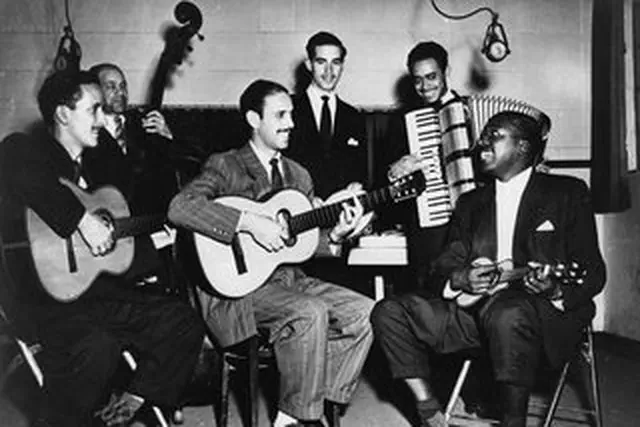
Digital Choro
Exploring the potential of digitization and computational models for Brazil's musical cultural heritage
View project →
Representing Harmony
Goals and Challenges
View project →
CODAMUS
Computational and Digital Approaches to Music Scholarship
View project →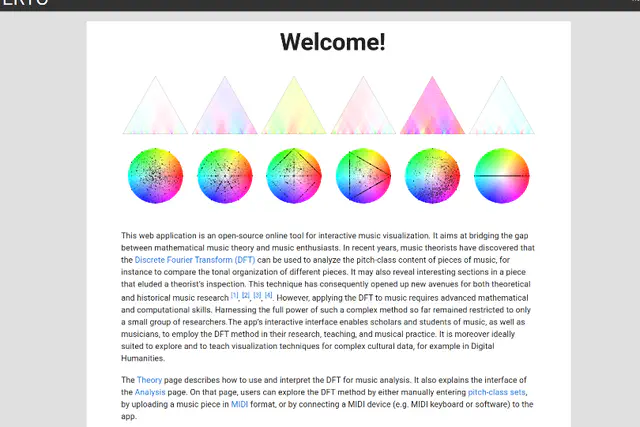
midiVERTO
Enabling interactive music visualization for a wider community
View project →Publications
Harmonic patterns in Brazilian choro, Western classical, and Anglophone popular music: a data-driven comparison
Towards a generative model of medieval chant
Mapping the space of harmonic cadences between Brazilian choro, jazz and Anglophone popular music
This paper reports on an experiment extends a methodology to analyze and compare harmonic progressions at moments of formal segmentation in different styles based on corpora of Roman numeral annotations, and deploys it to the styles of Brazilian choro, Anglophone popular and jazz music.
Inferring Communities of Medieval Music Manuscripts Using Stochastic Block Models
What can we learn from the content of surviving medieval music manuscripts about their cultural context?
A Bayesian Approach to Modality and Regionality in Medieval Chant
Diao Annotations for Heptatonic Pieces in the Chinese Collection of the Essen Folksong Database
Harmonic patterns in Brazilian choro
Studying Chord Properties from Audio: A Diachronic Analysis of Root, Bass, and Pitch-Class Content
Tong yun san gong theory: corpus evidence for the distinctions among three Chinese heptatonic diao
The Rest is Silence: Leveraging Unseen Species Models for Computational Musicology
How many composers are we missing in RISM? What percentage of medieval sources of Gregorian chant have we already cataloged? How many differences in music prints do we expect to find between editions? How large is the coverage of songs from genres of a folk music tradition? And how close are we in estimating the size of the harmonic vocabulary of a large number of composers?
Knowing when to stop: insights from ecology for building catalogues, collections, and corpora
How much are we still missing?
Corpus Troporum Dataset: A Digital Catalog of Trope Elements in Medieval Chant
We present a dataset of occurrences of so-called trope elements in manuscripts of European medieval chant.
Arcangelo Corelli – Trio Sonatas (A corpus of annotated scores)
Big Data = Großes Wissen? Herausforderungen der digital-vergleichenden Korpusforschung
Fourier Qualia Wavescapes: Hierarchical Analyses of Set Class Quality and Ambiguity
We introduce a novel perspective on set-class analysis combining the DFT magnitudes with the music visualisation technique of wavescapes.
Computational modeling of interval distributions in tonal space reveals paradigmatic stylistic changes in Western music history
In this study, we employ a computational model that formalizes music-theoretic conceptualizations of tonal space, and use it to infer the most likely interval distributions for pieces in a large corpus of music, represented as so-called ‘bags of tonal pitch classes’.
An Annotated Corpus of Tonal Piano Music from the Long 19th Century
We present a dataset of 264 annotated piano pieces of nine composers, composed in the long 19th century.
Historical Changes of Modes and their Substructure Modeled as Pitch Distributions in Plainchant from the 1100s to the 1500s
Here, we analyze more than 40 000 pieces of plainchant to better understand the evolution of modes and pitch distributions in a period of five centuries that saw the development of the Western modal practice.
Phantom Curves: Scientific Discovery through Interactive Music Visualization
We introduce phantom curves, a novel music-theoretical concept based on the discrete Fourier transform (DFT), and document the creative process that led to their discovery
Towards a Unified Model of Chords in Western Harmony
Wavescapes: A visual hierarchical analysis of tonality using the discrete Fourier transform
We introduce wavescapes, a novel visualization method for tonal hierarchies that combines the visual representation of keyscapes with music analysis based on the discrete Fourier transformation (DFT) and illustrate it by analyzing compositions by Josquin, Bach, Liszt, Chopin, Scriabin, Webern, Coltrane, and Ligeti.
Discovering Tonal Profiles with Latent Dirichlet Allocation
In this study, we use the Latent Dirichlet Allocation (LDA) topic model to discover tonal structures in a corpus of more than 2000 musical pieces from large historical range (ca. 600 years). and that the inferred topics have music-theoretically meaningful interpretations.